Rolfer, Dancer, Teacher

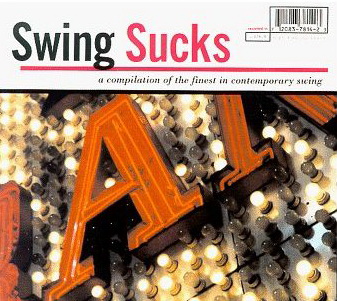
SwingSucksAlbumCoverI recently DJ’d a 20’s themed holiday party where my partner and I had been hired to teach a Charleston lesson and follow up with 20’s music, eventually transitioning into modern pop music. Due to a  few delays, and performances running long, we were eventually asked to scrub the lesson and move straight into playing music. Within the first song or two of 20’s music we immediately had people coming up to not-so-subtly ask when we would start playing modern music. The subtext of the request was pretty clear “We think this music sucks.”  We scrambled a little bit, threw on some club type music and the once empty floor was suddenly packed.

The variety of perceptions people have for the same tune was always been intriguing to me. It amazes me that someone could love the Cupid Shuffle or hate Jumpin’ at the Woodside. I was aware that I started dancing liking Neo-Swing but as my dancing grew I started to prefer first groove, then vintage, but I didn’t have a solid reason why. I’ve heard some great talks on this subject, from a musical perspective, by DJ and historian, Kyle Smith, and I’m in absolute agreement that there are a lot of factors to how we perceive music. For this post, I wanted to pick out one that I see as a particularly strong influence in what people will or won’t dance to: their own default movement.

All of us have our comfort zone and at the center of that comfort zone is our default. If we count ourselves off, we each tend to count off at a certain speed, syncopate a certain way, use a particular energy, etc.  If every song sounded the way that default song does, we would kill it every time we hit the dance floor.

Of course, not every song fits our comfort zone.  The vast variety of music defies our comfort zone, falling somewhere away from our default towards uncomfortable, or even inaccessible territory.  And this is where I think a breakdown occurs for a lot of people.  When the music no longer supports the way your body wants to dance, you have two choices, recognize the limitations of your body or blame the music.  I think the common “I don’t like this music,” is often an indication of people choosing the latter.

This isn’t to say that all music preferences are based in this, but whether or not the music supports your movement is something I don’t see many people pay attention to.  So in an out of sight, out of mind sort of way, it makes it easy for our comfort zone to flavor a lot of our stated musical tastes.  If your movement and the music don’t have a common thread to them, it begins to make dancing feel like an inappropriately soundtracked movie scene.

From the musical side, this is how I tend to approach things when I am DJing and want to fill the floor regardless of what music it takes (as opposed to wanting to play within certain genres).  I watch the way people move, particularly when they aren’t dancing, and try to figure out what would make an appropriate soundtrack.  I think most DJs do this to some extent when they talk about reading the floor.  Coming up with someone’s soundtrack is just one of the ways I conceive it and a way I have found translates well when helping new DJs develop their own feel for the floor.
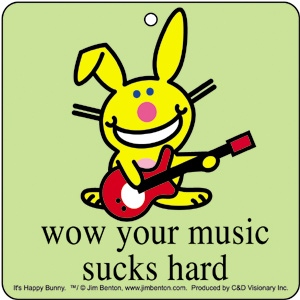
Sometimes the music is just bad.  But most of the time, I try not to be like this guy.

Sometimes the music is just bad. But most of the time, I try not to be like this guy.

As a dancer, I certainly have the option to just stick to my guns that X music sucks and not dance to it.  But I would prefer to dance more and dance better to the music I already like.  So from that perspective, my goal becomes expanding my movement repertoire and getting better at moving based on the music rather than moving based purely on my preexisting habits.  It can be a challenging process at times, but I find a great deal has opened up in my dancing as I developed a willingness to move with the music and move to more types of music.  Here are a few things that helped for me:

Stop and Listen

One of the things that locks us into old patterns is jumping the gun because we feel like we have to move immediately.  When they connect with a partner, most people will start in dancing almost immediately because waiting could create the dance equivalent of an uncomfortable silence.  Starting simply with pulsing to the music and letting the music fill that silence does a lot, both for the musicality of the dance and for making the partnership feel like you are on the same page.

Move By Yourself

In dance classes, when I put on a swing song and ask people to move on their own, inevitably, some percentage of the class will start doing nothing but 6 and 8-count footwork in place.  The whole of the music is there for the taking but they have become so deeply patterned that the first instinct is to do something completely by rote.  As you spend time just getting used to moving alone, you can put more focus on deepening the relationship between your body movement and the music.  The stronger that relationship gets, the more you will be able to take it back into a partnership.  This tends to involve a lot of trial and error and may be uncomfortable at times, but the dance rewards are well worth the effort.

Find Transitions

If I’m DJing a mixed genre night and I want to go from funk to charleston, it would be a rather jarring transition in most cases to do so in one song.  If I find an intermediary song or two that allows me to shift the genre over time rather than a straight change, the energy of the night can be maintained and dancers are better primed for the genre I’m heading towards.  The same goes for your body and your own dance development.  Knowing where you are and working towards other styles of movement piece-by-piece allows you to make use of the resources you already have.  If you like dancing to neo-swing and want to get a feel for vintage, try starting with neo, moving to more modern swing bands, and then working your way back to vintage music.  Whether or not your dancing “feels right” to the music or feels jarring will be a good indicator of when you’ve got it and are in a solid position to expand your comfort zone further.

So the next time you think the music sucks, take a minute and consider how your dancing may or may not line up with the music.  You certainly don’t have to like anything you don’t want to, but if you are willing to step outside of your comfort zone you might find that you can enjoy dancing to something that didn’t grab you at first.  And if you’re of the “I’ll dance to anything” variety, you can use the same tools to deepen your connection with a variety of musical genres and find deeper inspiration in the music.  Whatever your choices, just keep in mind that your musical taste is often as much or more about how the music makes you feel than it is about the music itself.  And whatever makes you feel like you want to dance, start there, and you can use it to grow beyond.

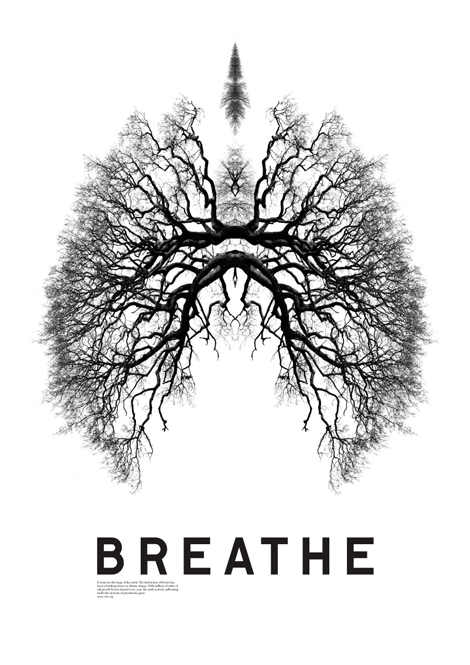
tight stone fist

“relax”

“Relax”

“RELAX”

I cringed a little watching this exchange between a massage therapist and a client. The massage therapist was trying to get her client to release tension in her arm. The woman on the table was having trouble relaxing and the massage therapist was becoming frustrated by the client’s lack of response. The client, not too surprisingly, seemed less and less relaxed as the therapist became louder and more insistent.

I have seen similar situations play out in dance classes where well-meaning instructors have created traumatic situations for students by pushing them to relax. I have talked to students who were reduced to tears after a private lesson where they were just told over and over to relax. And I recently had a student who really needed to relax thank me for finding more active release-oriented ways to cue her because a previous ballroom teacher had essentially beaten her over the head with the word “relax” to the point where she hated/feared hearing it.

“Relax” can be an extremely difficult instruction to execute. It seems a great many instructors, students, and people in general don’t have alternative strategies to try when “relax” isn’t effective. So when “relax” doesn’t work, they don’t have a backup wording and just keep saying the same thing that didn’t work the first time. Then they go on repeating “relax” like a mantra until they give up or manage or contort themselves into something that looks close enough that they can move on.

What makes “relax” so hard?

For starters, context. People typically get told to relax in situations where they are already tense, meaning they are under some sort of stress or sense of danger. Telling someone to relax in such a situation is essentially asking them to turn off a defense mechanism when they feel threatened. Frequently, people who are tense because of some fear of judgement end up tensing even more when told to relax because they fear being unable to comply and being judged further.

Relax is also a fairly complex concept, when you think about it. Not only does it involve a change in physical state, but also a mental/emotional shift. And for relaxing to make sense to your nervous system, you need to view your current surroundings as non-threatening. If any of these tensions are habitual, it can even be difficult to tell that you are tense in the first place. With all these factors involved, relax becomes more a state of being than a simple action.

Many people seem to conceptualize relax as the absence of doing something. In the US, the tendency to fill our lives with doing things can make the idea of relaxing seem to equal doing nothing or even being viewed as a negative. Rather than viewing relaxation as a lack of doing, it can be far more productive to approach it as an active releasing of tension. The following few ways can help you to physically and mentally achieve relaxation more effectively than just thinking “relax.”

Breathe

breathelungsOne of my first cues anytime I find myself tense is to extend my breathing. Taking a longer breath, and particularly a longer exhale, activates the relaxation response. Under the sort of duress that causes tension, most of us will shorten or even hold our breath, reinforcing the tension. Deep, slow breathing helps to settle the nervous system and bring it back to a state of ease, leading the muscles to relax without direct, conscious effort.

You can also direct breath towards particular areas that need help relaxing. Shoulder tense? Try focusing on the area in your chest near that shoulder and imagine directing your breath to it. The expansion of the lungs is a great way to passively expand muscle groups and give them more space to settle into more comfortable and relaxed positions.

Think Down

The body responds much better to simple directional ideas than it does to complex concepts like “relax.” The end goal of relaxing can often be achieved by thinking about letting the arms (or whatever body part) sink down.

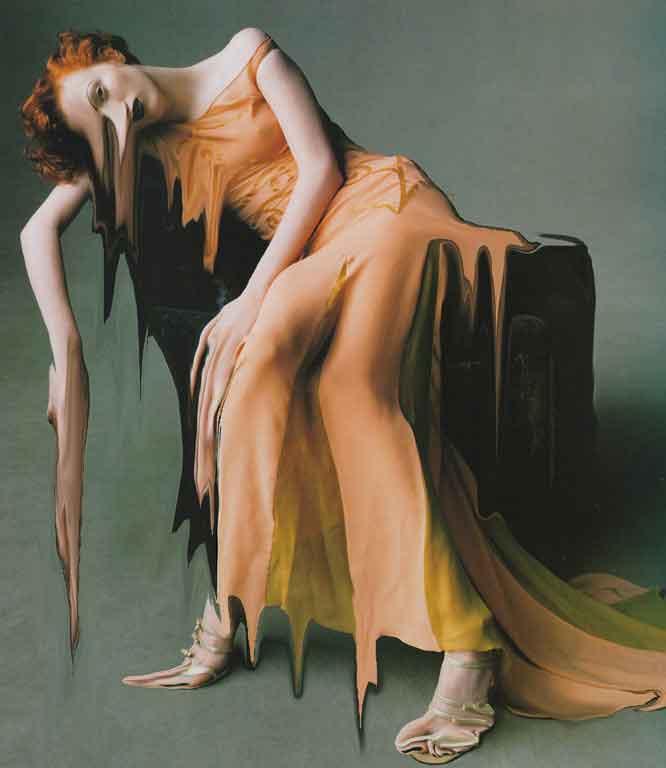
melting_womanIn many dance contexts I’ve seen teachers repeatedly asking students to relax their arms, often with minimal to moderate success. Often, this arm tension is based on the idea that someone needs to hold their own arms up. So a great deal of tension is a result of fighting gravity to keep the arms at some specific height. By thinking about allowing the arms to sink down, the body can surrender to the effects of gravity and work with it, rather than constantly fighting it. I often use the idea of melting like candle wax to enhance this effect in relaxing. Because a relaxed arm will more effectively transfer motion, this sort of release is integral to creating natural connection in dancing.

ghostbusters-floating-danaI see the same effect on my Rolfing® table where many people’s bodies tense away from the table almost as if they could levitate themselves by sheer force of will. When I prompt them to recognize that the table can support their weight and to let themselves sink into that support, their bodies relax and their mental state follows suit shortly after. In standing, a similar effect is achievable by becoming aware of the bones in your body and allowing weight to carry through bones rather than be held up by muscle.
Tense & Release

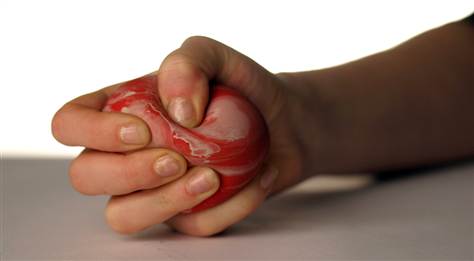
One of the more counter-intuitive moves for relaxation is to tense up first. Most of us, when told to relax, will aim to go directly towards some sort of relaxing attempt. stress ballHowever, it can end up more effective to tense muscles first, hold that tension for a few seconds, and then allow them to relax. In essence, taking yourself into greater tension allows for a better release.

Because many of us carry constant tensions, it can be easy for the brain to begin filtering out these sensations. I often hear people remark that they had no idea they were tense in so many places. By creating a conscious tension in the muscle first, the difference between tense and relaxed can become more apparent, which helps you feel yourself relax. This technique is also used by some physical therapists, terming it Progressive Muscle Relaxation, to treat general anxiety issues.

The 3 ideas above are just starter ideas, feel free to modify them or come up with your own. The more tools you have, the more you can help someone else relax or have options to try when someone tells you to relax.

In any case, keep in mind that attempting to produce a relaxed state involves physical, mental, and emotional aspects. Shifting any one aspect can help to shift the whole.  So when you are having trouble relaxing, focus on a simpler version of it, releasing a part of the body, slowing your breathing, calming your thoughts, instead of trying to do everything at once. And just like working out a muscle, the more you work with these ideas, the stronger they become and the more readily they will help you to achieve relaxation.

Remember the first time you held hands with a boy or girl you were interested in?  The moment of tension when you first make contact, waiting to see if he or she will pull away, holding your breath, the fear of having made the wrong move, and then finally relaxing into the contact.  A variation of this sequence happens every time you make contact to start a dance with someone.  But many of us miss the relaxing phase and get stuck somewhere in the “eek” territory.

The sympathetic nervous system at work

A visual approximation of the sympathetic nervous system response 😉

Whether you call it nerves, intimidation, needing to relax, etc., that moment of tension is an activation of the sympathetic nervous system.  This activation is also referred to as the fight or flight response and can involve a number of physiological reactions including increased heart rate, sweating, and increased muscle tension.  When we view something in a dance (or elsewhere for that matter) as a potential threat,  we often resort to a form of the sympathetic nervous system response, mitigating our anxiety by shunting the emotional reaction into physical tension.

Threat Assessment

When you first contact another object, whether it’s an inanimate object or another human being, your body goes through what is essentially a threat assessment.  This is a very primal reaction seen in even simple organisms and is a very important survival instant throughout the animal kingdom.  You can think of this like the bouncer at the door of a club.  Situations that the brain deems safe get past and the body relaxes; threatening situations are tagged “not on the list” and the body reacts to prevent them getting in.  Because this reaction needs to be a very rapid response, in survival situations most of this assessment is based on past experiences.  Like the bouncer’s list, situations are either on the list (safe) or not on the list (potentially dangerous).

In it’s origins, this threat assessment related primarily to physical danger.  As organisms became more complex and eventually developed social groups, potential threats to survival became more complex as well.  While they do not pose immediate physical threats, things like judgement and rejection have become very real fears that can elevate stress levels and activate the sympathetic nervous system.  When this system is activated, a number of physical effects are kicked off that can interfere with dancing.

Fight, Flight, or Freeze

Each time you start a dance with someone, your body goes through this threat assessment.  If you are well accustomed to dancing and the contact that goes with it, relatively sure of your partner’s skill to not injure you, etc. then dancing makes the “list” and you can relax into the experience.  For most advanced dancers, this assessment often happens so quickly that it can be easy to forget that it even happens.  However, if any of a number of factors are unfamiliar, the situation may be deemed “not on the list” and the body will respond by elevating stress levels and activating the sympathetic nervous system.

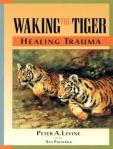
waking-the-tiger-healing-traumaWhile we typically know the sympathetic response as “fight or flight” there is a third option to the response, the “freeze” response described in the book Waking the Tiger by Peter Levine.  The freeze response can be useful in nature as a “play dead” reaction or going limp in the face of overwhelming trauma can sometimes help minimize otherwise catastrophic injuries.  In the dance world, I think the freeze response is highly prevalent in the form of reactions like the “deer in headlights” look or the “oh crap, someone better asked me to dance and I don’t want to screw up their cool moves” sorts of thinking.  I believe the freeze response is what many instructors are seeing when they ask students to relax.

The involvement of the sympathetic nervous system is one of the reasons that the oft-given “just relax” advice can be difficult to put into practice (more on that in another post).  If your mind/body views a situation as dangerous, it would be essentially an illogical move to relax into a dangerous situation.  Rather, the goal the I find works better is to find ways to rewrite the “list” so that the situation is no longer viewed as potentially threatening.  Simply being aware that you have the “freeze” reaction in dancing can help to calm it.  Bringing attention to the threat assessment stage helps you complete it rather than becoming stuck in a tense state.

Where I think many dancers find it difficult to relax is because they actually fail to recognize that they see a threat in the first place.  In the non-dancing world, the level of contact you have with the average dance partner (holding hands, 3+ minute extended contact, inside normal conversational range) would be reserved for extremely close friends or often exclusive to someone you are in a romantic relationship with.  Because a new or even experienced dancer may be unfamiliar with a partner or not used to the closeness, the nervous system may treat this extended close contact as a potential threat.  Or even if you are familiar with your dance partner and close contact, anxieties about potential judgement, rejection, or imperfection can easily cause the same subtle assumption of threat.

Redefining Boundaries

So how does one handle these assumed threats?  Simply put, by redefining how you think about them so that you can view them as safe rather than threatening.  The rules of contact, that may work in the social world, operate differently in the context of dance.  Where a stranger touching your back could be a danger signal on the street, dance (and respectful dance partners) provide a space you can use to redefine that contact as a safe form of touch.  When someone approaches or touches you in a dance and you notice yourself tensing, take a second and remind yourself that it is not causing you any immediate physical danger.  Actively recognizing that you are in a safe space will help your nervous system to stop reading contact in dance situations as dangerous.

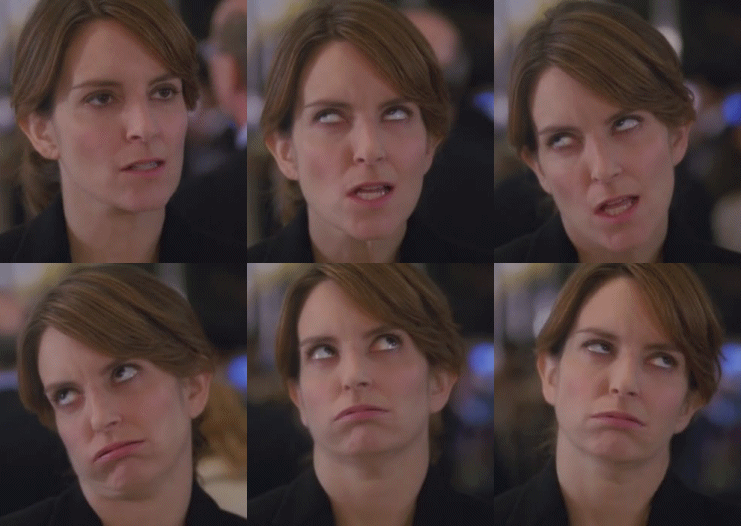
Note that most people do not make this face when dancing with you

Note that most people do not make this face when dancing with you

In addition to changing your response to touch, it is equally important to redefine the social assumptions.  This can happen to dancers at any level, but I find many beginners tend to believe that people are judging them or dislike dancing with them.  The assumption that people are judging your dancing often makes people tense, rigid, and represses the joy in their dancing.  I find the simplest practice to change this is to reflect on whether or not you are judging other people.  Many of us assume we are being judged, yet when we think about it, we spend little to none of our time judging others while dancing.  You probably don’t spend entire dances rolling your eyes about your terrible dance partner, so why expect that your partner is rolling their eyes about you?  Recognizing that you don’t spend every dance constantly judging your partner is a good first step towards breaking the assumption that your dance partners are constantly judging you.

I think that for most people, the most effective way to deal with these stressors is to start by acknowledging them.  If you are aware that your sympathetic nervous system response is making you tense, you can take steps to shake it off and remodel your thinking to consider certain situations safer.  Being aware of these mechanisms can help all levels of dancers to better settle their fears and gain comfort and confidence in various dance (and other) situations.  While the strategies for building confidence are varied, I think the following video does a solid job of breaking down the general idea of stressors and how to change your thinking around it.

Starting with simple awareness of the sympathetic nervous system reaction can do a lot towards helping shift the reaction.  There is a lot more to be said about how to work with it further, but in the interest of keeping posts to a readable length, I’ll end here and write more about that in the next few weeks.

Monopoly ManI’ve been fielding a lot of questions recently about why RDU Rent Party came about and how various things work.  So in the interest of not repeating myself too often, I figured I’d put the basic history and premise down in a post.  I have some other things to say about why I love running it and why I think it has been such a successful venture, but for now I’ll just stick to the basic story.
Humble Beginnings

The first RDU Rent Party, although it didn’t go by the name Rent Party at the time, happened as a result of a last minute need.  Solomon Douglas was on tour and had been booked by the local swing dance society on a Sunday (not their normal Saturday night).  At the time, TSDS was struggling financially and made a last minute decision that they would have to cancel the Sunday dance.  Suddenly gigless mid-tour, Solomon called Laura Windley, who then called me and asked if I could help put something together to host a dance so that the band could make some money and not have to eat an entire night’s wages.

I’ll back up just a sec here to say that up until this time, I generally avoided anything akin to organizing like the plague.  I didn’t want the responsibility and as much as I might have gained some comfort teaching dance classes, you couldn’t pay me enough to make me want to talk on a microphone back then.

In this case, though, the situation just seemed to demand that someone do something.  So, we quickly booked a room at Triangle Dance Studio and being that it was just the two of us, we decided to just put out a hat box (no surprise Laura had several handy) and take donations on the honor system.  At this point, the specifics of the night are lost to me, but I definitely recall enjoying myself and a great sense of accomplishment in helping the band bridge the gap and giving the local scene a chance to dance to a band they would have otherwise missed out on.

Edition 1: A New Hope

Robot Chicken Star Wars imageBased on the success of the dance with Solomon Douglas and the struggling state of TSDS at the time, Laura and I got it in our heads to try our hand at running a few more dances, aiming to work with musicians who we felt brought a kind of energy that the Triangle scene had been missing for a while.  It made sense to continue using the pay-what-you-can honor system with the hat box as we didn’t want to wrangle door volunteers.  Neither of us wanted to make money off of it, so we opted in the early days to pay for the space and give the remainder to the band.  After the second or third dance we ran and some nights making less for the band than hoped, I decided to start funding Rent Party out of pocket and since then the space rental for Rent Party has been sponsored by one of my businesses, Raleigh Rolfing or The Lindy Lab.

It’s funny looking back how small moments created bigger themes, but the whole edition/theme flavor of our ad copy came about from the simple act of Laura Windley buying cookie cutters.  At the time, Laura was singing with the Atomic Rhythm All-Stars and occasionally with their smaller combo George Knott’s Square Trio.  Because our attendance was smaller back then, we tried to hire small groups to make sure we could pay the individual musicians decently.  So we had offered a gig to the Trio and it just so happened that Laura had purchased Star Wars cookie cutters around the same time and was looking for an excuse to use them.  The entire “Star Wars Edition” idea was born out of those cookie cutters and went on to inspire a DJ/lightsaber battle and someone bringing a Death Star themed pie.  It seemed to engage people and I found myself surprisingly enjoying writing ad copy, and so the idea stuck.  Every dance since has had some sort of them that gives us a chance to make the dance feel like a special event and gives me a creative writing outlet.

One, Two, Skip a Few…

With some initial success, Rent Party got on a roll and was able to host some fantastic bands and artists who had never played in the triangle before.  We also got to try some ideas that might not have otherwise have flown or been disruptive to a typical dance night.  I have loved every Rent Party we’ve thrown, but a few of the highlights for me have been

  • Catching Glenn Crytzer mid-tour for his first Triangle appearance and a Gatsby Edition party where we got in trouble for serving alcohol.
  • Another first for the Triangle with Meschiya Lake and the Little Big Horns with a prohibition repeal celebration.
  • Rent Party’s only DJ’d night, the Inappropriate Edition, which featured nothing but sexual, drug referencing, or racist songs.  This night also raised funds to help pay for the Triangle Tap Project’s band battle between the Russ Wilson Swingtet and the Atomic Rhythm All-Stars.
  • The Ragtime Edition dance where Ethan Uslan was massively entertaining on piano alone, something a number of people told us wouldn’t work for a swing dance.
  • And my absolute proudest moment with Rent Party so far, the Floyd Council Memorial Edition featuring 4 exceptional local blues musicians, who were phenomenal to dance and listen to, plus we nearly had a fight break out and one of their non-dancer fans offered me moonshine. 🙂

To Infinity and Beyond (Maybe)

One of the great things to me about Rent Party is that there is no schedule.  We run it because we want to run it, and if we ever get burned out, we feel free to stop.  Plus, we only run it when bands are available, so if none of the bands we want to work with are free, no sweat, we just wait until a good one becomes available.  That said, as long as the bands keep bringing it and people keep showing up and paying for great music, we are more than happy to keep Rent Party going.  We’ve found a great niche in the scene at this point as the small flexible counterpoint to TSDS.  We don’t expect we’ll ever have the clout to pull big bands on a Saturday night like TSDS does, but we can host great bands on off nights, be a testing ground for bands that don’t fit a larger dance, or even work with current dance bands in new and different ways.  I’m happy to have found a niche for our “little dance that could” and as long as it’s fun and interesting, we are thrilled to keep producing it.

Laura and I both greatly appreciate the support that the community and musicians have shown to Rent Party and we look forward to producing more awesome and weird and awesomely weird dances this year. 🙂

As a dancer and Rolfer®, I find myself constantly searching for simple, elegant ways to describe complex concepts in movement.  One such concept that often seems difficult to describe in swing dancing is frame.  Most often I hear overly simplified images like “Barbie doll arms,” or models like “relaxed but with tone” that involve complex ideas and can be confusing.  So in my search for a singular concept to encompass all these pieces, I have found myself over the past year drawing on a concept I first encountered during my training to be a Rolfer.

The way I currently approach swing dancing frame is that it behaves like a non-Newtonian fluid.  Since most people are not immediately familiar with what that means, let’s start with a definition.

A non-Newtonian fluid is a liquid which has a variable viscosity depending upon circumstances.  In simple terms, this means that the substance behaves like a liquid under some circumstances and more like a solid under other circumstances.  The common example that most of us will be familiar with is ketchup.  Glass bottled ketchup will tend to behave more like a solid when you first turn the bottle to pour it, but once you start it flowing by shaking it or poking it with a knife, it will continue to flow smoothly.  For the purposes of describing frame, I will be using a different non-Newtonian fluid by the Dr. Seuss inspired name Oobleck.

Oobleck is a soupy suspension of cornstarch in water that exhibits shear thickening, meaning that under pressure the fluid behaves temporarily like a solid and then returns to a liquid state when the pressure releases. So with a tub of Oobleck, if you were to say, punch it, you will essentially bounce off as though the material is a rubbery solid, whereas setting a hand on it and simply sinking, the Oobleck will remain in a liquid state.  This effect often gets used in science shows as a way to “walk on water” as you can see below.

This change in viscosity occurs due to what one scientist refers to as the “Three Stooges Effect” which is to say that under pressure, the molecules in the Oobleck are trying to move too fast through a space together and get stuck, as in when all three Stooges attempt to walk through a door at the same time.  So the material changes it’s state in response to force, reactively instead of proactively.  It is this combination of fluidity and reactivity that, to me, makes it such an apt image for swing dance frame.

In a dance context, I use the idea of non-Newtonian fluid to influence any point of contact I am using with my partner.  When we are in a neutral state relative to each other, shoulders, arms, forearms, and hands remain in a relaxed fluid state.  But when our bodies move closer or further away from each other with a strong force, the arms react by acting more solidly to resist the change.  I don’t think about actively relaxing or tensing my arms with these changes, I think of them as constantly seeking a fluid state, but reacting under pressure to resist change when force is applied.  By doing so, my arms communicate the motion of my body relative to my partner.  Rather than being instruments of leading or following, when the arms behave like a non-Newtonian fluid, they simply become a way to transmit force from one body to another and can communicate equally from lead to follow or follow to lead.  And as an added benefit, it leaves my muscles feeling good after a dance instead of worn down by constant work to maintain a specific shape or create constant tension.

This is not to say that frame behaves this way at all times, I think there are always exceptions (and there is probably an exception to that) but this idea of non-Newtonian fluidity in frame is an underlying principle of how I think of frame in swing dancing.  Non-Newtonian fluid is, at this point, the best single image I have come up with encompass the use of both ease and tension in creating connected frame.

Note: If you want to try making your own Oobleck to get a feel for how this material behaves, simply combine 1 cup of water with 1.5 to 2 cups of cornstarch and mix thoroughly.

There has been a lot in the news recently about the outbreak of fungal meningitis linked to contaminated steroid injections.  With the increasing industrialization of our health care system, we as patients and our doctors as providers are becoming more removed from direct knowledge of the drugs we take to manage pain.  I am often surprised at the willingness Americans have to pop a synthetic pill or go under the surgical knife as a first treatment rather than a last resort to dealing with pain.  There are many options that exist today which can treat the actual causes of physical pain and provide a number of other health benefits as well.  Rolfing® can help provide long-term relief from issues like back pain by addressing not just the symptom but the underlying structural causes and it does so without the use of drugs.

Rolfing is a therapy based on hands-on manipulation of fascia, the connective tissue that forms ligaments and tendons in the body.  In contrast to steroid injections which work by limiting the immune system response and dampening inflammation, Rolfing works by creating space in the body allowing for better movement and circulation and allowing inflammation to clear on it’s own.  Rolfing has also grown over the years to encompass elements of addressing the nervous system and movement patterns that reinforce painful posturing or movements.  Rolfing also involves no injections or pharmaceuticals so there is no need to worry about current issues like life-threatening infections from contaminated steroid injections.  Beyond not being linked to infections, there are a numbers of reasons that Rolfing is a much more effective therapy to consider.

Rolfing provides additional health benefits

Steroid injections and a great many other standard medical treatments are designed with insurance in mind to directly treat a singular issues and only that issues.  Rolfing, rather than being simply a quick fix is based around the idea of fostering health rather.  A Rolfed body stands taller and moves more fluidly.  Clients often report feeling more like themselves and most note improvements in sleeping and energy levels through a course of Rolfing sessions.  Rolfing also frequently helps the body to strengthen it’s own structural support leading to a reduction in in frequency or severity of future injuries.

Rolfing does not come with a list of side effects

A quick check of WebMD for methylprednisolone acetate (the injection linked to cases of contamination) reveals a list of rather nasty side effects including vomiting, dizziness, trouble sleeping, appetite changes and pain/redness/swelling at the injection site.  While I think it is fair to say that many of these side effects are probably preferable to months of chronic pain, there are also treatments available such as Rolfing that don’t come with a list of side effects.

Rolfing involves the personal touch of a local provider

With the increasing industrialization of pharmaceuticals, we are much less likely to have a personal relationship with our prescription provider than we did 20 years ago.  With the myriad drug interactions out there, it becomes much easier to miss something if your provider is a large remote company.  A Rolfer will work with you one-on-one and typically spends an hour or more with you on each treatment.  And a Rolfer will treat you as an individual whole person and adjust treatments on the fly according to your needs.

None of this is to say that corticosteroids are inherently bad.  I have known people who had great results with them, and I have also helped a lot of clients who didn’t respond to steroid injections.  Any treatment has advantages and drawbacks and I think it is important for people concerned about their own health to consider the alternatives and weigh the benefits of allopathic treatments versus the benefits of other modalities.

For more information on Rolfing therapies in the Raleigh/Durham area, you can visit RaleighRolfing.com.  To learn more about Rolfing in general or find a Rolfer in your area, you can visit the Rolf Institute of Structural Integration website at Rolf.org.

Continued from Part 4: Modern Lindy Leads

So where does all this talk about up and down get us?  Much like a number of classes that I’ve taken recently from Bobby and Kate or at The Experiment, the idea here is that self knowledge allows you to better assess both strengths and weaknesses.  By knowing your strengths, you can pick motions and stylings that appeal to your natural tendencies and by knowing your “weaknesses” you can start to view them as simply areas for improvement and then work on them.  For instance, I recently realized in the course of writing this article, that the way I originally learned Charleston lacked up energy.  For years my Charleston has felt heavy and clunky and it wasn’t obvious why.  When I began working with including Up in my Charleston, my dancing immediately began to feel lighter and more dynamic, and my pulse felt more in-tune with the music.

Developing a stronger vertical orientation tends to work best through the cultivation of imagery. While you can get some benefit out of simply thinking “There’s no place like up,” most people find that creating more detailed imagery helps them make progress faster.  Below are a few examples of such imagery which you can use as is or to inspire your own imagery.

Accessing Up

My favorite image for accessing up is a variation on Christmas ornaments.  Imagine a string suspending you from the ceiling or some other imagined point above you.  Start with the idea of a string attached to the top of your head that is being pulled gently upwards.  As it pulls upwards, allow your body to hang from the string, dangling freely beneath your head.  Notice if your spine or neck lengthen or relax and how your weight shifts on your feet.  As you get comfortable with the lifted feeling in your spine, you can begin to play with adding imaginary strings to the arms, legs, feet, and hands, imagining yourself as a marionette.

Up imagery can also be used to exhance down movements.  Most of us find our shoulders creeping up towards our ears in times of stress.  In such situation, it can be difficult to directly push the shoulders back and down.  However, allowing your shoulders to actively rise up can prime them to relax and sink back to a less strained position.  To try this, create an image of your shoulders being suspended from strings then imagine the strings pulling upward, lifting your shoulders towards your head.  Settle into this lifted feeling for a few breaths, then slowly imagine the strings releasing downward and allow the weight of your shoulders and arms arms to sink with them.  Keep imagining the strings slowly releasing downward until you reach an end point and notice if your shoulders have changed position.

Accessing Down

Down is an idea that shows up a lot in Lindy.  Concepts like pulse, using the floor, and counter-balance all require use of down energy, typically in ways that we don’t necessarily practice in daily life.  I find most people can conceptually understand the idea of using the floor or grounding, but it frequently takes some deeper work to be able to feel down energy for themselves and understand it on a visceral level.

The image I like to use to access down energy is growing roots.  Start from standing or sitting, preferably in bare feet and a comfortable position.  Imagine your feet or your tailbone beginning to grow long tap roots down into the floor.  Allow the image of the roots to expand at it’s own pace and notice if your posture shifts or settles in reaction to the image of roots.  As they grow, you can imagine the roots going deeper or spreading outward with a wider reach.  Allow the root image to expand to a comfortable distance and settle into it for a minute or two.  Notice any energetic or emotional shifts, for instance many people find a strong down image helps foster a sense of calm and stability.

As you gain confidence with the down imagery, you can start taking it into motions like walking, imaging roots reaching into the ground with each step.  The better you get at pushing or rooting through the ground this way, the more it can support upward movements as well.  For instance, in jumping, you can get more height by pushing off the floor as if you were pushing through it rather than pushing at the surface of it.  And serious power lifters derive their power in moves like squats not just from pushing at the floor but pushing through it.

How these images work

The general concept of these images is to help create attention beyond the physical confines of your body.  This expanded attention helps gives you more sensory input which helps with orienting motion and creating extension in movements.  By expanding the sense of space that your body can move in, more of your muscle becomes active in creating motion and the outward attention helps to activate deep postural muscles.  The more comfortable your sensory system is extending attention beyond your body, the more readily your body will create action into those spaces.

While these exercises may not immediately seem dance related, the concepts they help you access can be seen in many great dancers.  They won’t make you an amazing dancer overnight, but consistent practice will help open up new avenues for movement and expression.

I would like to leave you with an image of what is possible with this sort of expansive attention and presence.  Mikhail Baryshnikov at 5′ 6″ was not a large man, but his immense presence on stage gave him an amazing ability to seem as if he could fill the whole space with his dancing alone.  I could go into detail describing this, but I think it’s best to let his dancing do the talking.

Continued from Part 3: Modern Lindy Follows

So how does this up/down orientation affect dancing among leaders?  As someone who predominantly leads, I noticed in writing this that I had somewhat more concrete ideas of what a lead’s orientation should be.  My first lessons in Lindy actually came from a West Coast Swing instructor that involved a lot of anchoring and creating a grounded pivot point, etc.  Writing this post, I was reminded that there is a lot more room for variation than what I was originally taught.

As in the previous follower post, I’ll be using a selection of three modern Lindy leads to illustrate a very general idea of the differences that an up, down, or more evenly split orientation can produce.  Most of us will naturally be drawn more to one aesthetic than the others, but I recommend trying to watch this with a certain neutrality.  Each of these dancers and orientations has benefits and drawbacks and lend themselves to certain moves or visuals.

For the leads, I have selected Juan Villafane as a good example of upward orientation, Peter Strom as a representation of downward, and Skye Humphries as an example of a more evenly split orientation.  I think it is also worth noting that the clips of Juan and Peter have a second song where they were given a choice between neo-swing and club music.  Each of them end up dancing to a style of music that compliments their orientation (the up of Neo-Swing for Juan and the down of Super Club Jam for Peter).

Up Orientation – Juan Villafane

Watching Juan’s dancing, it is easy to see how he and Sharon Davis ended up paired together stylistically.  Juan has a similarly floaty style of motion driven by an upward orientation in his dancing.  Juan’s triples tend to move as if they are hanging from his body, giving an interesting sliding quality to his footwork.  On his rocksteps, you can see Juan’s foot tends to travel back more laterally, hanging in the air more than digging into the floor behind him.  This upward orientation also gives him some options to use his torso and arms more to drive motion.  On a few swingouts and side passes you can see Juan move as much or more than his partner and actually begin moving himself off of her before she begins to move.  On his spin around :59, Juan’s lightness helps him to move off of Laura’s anchoring and into a spin.  And finally, at 3:05 you can see how Juan uses more of an upward motion to recover from his split.  On his first attempt to come up, his arms are not involved, but on the second attempt as he starts to reach back and up with his right arm, he is able to pop up easily.  Overall, Juan’s up orientation lends a lightness to his movement and a strong ability to use his partner’s connection to aid in his own movement.

Down Orientation – Peter Strom

Peter Strom is someone I consider to have a strong down orientation to his dancing.  As you watch him move, you can see the dynamic and energy of his movement shift as he moves between an upright posture and a more down motion.  In a sense, Peter can cruise when he is more upright, but when he’s turning up the energy, he drops down more and gets a lot of his energy out of his legs and the ground.  In contrast to Juan’s rocksteps, you can see Peter’s rockstep tends to extend back a bit less but digs down into the floor more.  You can also see Peter really uses the floor more than his partner to make dynamic motion shifts, as in the fast direction change he makes at 1:30.  And in the club section, very little of Peter’s moves emphasize the up section of movement.  All of his solo dance moves tend to involve a sharper motion and emphasis on the down portion of the step.  Overall, Peter’s down orientation lends him a dynamic use of the floor and a sharper, more athletic sense to his movement and styling.

Evenly Split Orientation – Skye Humphries

Skye is another one of those dancers who has always seemed to make dancing effortless.  It occurred to me in writing this article that part of it, much like Mia, is that he seems to move up and down with an equal sense of comfort.  Skye flows through both jumps and drops at a pretty even rate and without hesitation in either direction.  He seems equally able to use his partner to redirect his movements (1:05 and 1:13) or use the ground to redirect (:49).  In many of Skye’s movements, you can see him actively extending in multiple directions simultaneously.  For instance, in the hopping section at :34 you can see Skye’s feet still reaching for and using the ground while his torso actively extends upwards.  Overall, Skye’s split orientation gives him the ability to make a wide variety of movements appear very relaxed and fluid.

As with the follows, none of these options are the right way to dance.  These are just three examples of points along a spectrum of what is possible.  It should also be noted that while I have referred to Juan and Peter as up or down oriented, it does not mean that Juan has no down and Peter has no up.  Simply that they have developed their ability to use one direction more than another.

Everyone has natural tendencies and styles of movement that come easier to them than others, but it is also entirely within reach to work on and develop your abilities with your less natural direction.  In my next post, I’ll talk a bit more about how to begin developing each orientation and how to assess your own natural tendency.

Continues in Part 5: Developing Your Own Orientation

Continued from Part 2: Cultural Differences

So how do these up and down orientations apply to the modern swing dance world? The way most swing dances are taught now seems to emphasize down, pulse and grounding. But if you look at modern dancers, you can see many different levels of up or down orientation.

We are engaged in a dance with a history of downward orientation, as opposed to the “up” of many ballroom dances. Yet all of us come to it from our own backgrounds, cultures, prior dance training (for some), etc. and this can influence how we approach things. There is no right or wrong orientation but all those aspects influence how each of us dances and moves in general. In essence, your directional orientation can be both an aspect of technique and an artistic influence on how an individual dances.

In an effort to narrow this down, I have selected 3 follows who I think solidly represent a more upward, downward, or evenly split orientation. I made this selection purely on visual evidence from various youtube clips, so while they look one way, it is entirely possible that they may feel different to dance with. And while most of us will aesthetically prefer one movement style to another, this is intended to be a neutral assessment of what each style produces in motion.

So without further ado, representing up is Sharon Davis, down is Frida Segerdal, and the midpoint is Mia Goldsmith. As with previous posts, I recommend watching the video first to draw your own conclusions.

Up Orientation – Sharon Davis

Sharon, to my eye, shows a strong up orientation and an almost floating style of travel. Similar to Fred Astaire in my previous post, Sharon’s legs seem more to hang from her body and float down to the ground rather than being driven into it. While she is willing and able to sink into things, you can also see a certain hesitancy in her body to move in that direction. At :24 and 1:45 there are two downward level changes which Sharon floats into at first then has to shift for a moment before dropping into them. The floating of her torso also allows her to accentuate her hips in the swivels at :40. Overall, Sharon’s upward tendency offers her a very smooth and flowy look and stylings.

Down orientation – Frida Segerdahl

In contrast with Sharon’s floating pulse, you can almost immediately see a larger, sharper down in Frida’s pulsing. In the first 6 seconds or so when Frida is stood upright in closed, her motion seems a bit restrained, but as soon as she is released out into open, you can see her posture drop and a strong athleticism take over.  When Frida takes steps, you can see her feet driving down towards the ground, each step very deliberately pushed into the floor.  While Frida uses a lot of levels in her dancing, there is a sharpness to her downward stylings that I don’t see in her jumps.  Her drop/bend at :31 and the lock turn at :57 are prime examples of how she drives through her downward motions.  At around 1:30 you can see her swivels accentuate the knees and have a bit more of a lateral (side-to-side) motion.  Overall, Frida’s downward orientation gives her a strongly athletic look, sharp footwork, and helps her move across the floor very quickly.

Evenly Split orientation – Mia Goldsmith

Mia has always impressed me as one of the most composed looking followers in the Swing world.    In writing this post, I realized that part of it is that she appears to have an almost equal comfort level with moving up or down.  Mia seems at ease whether doing high kicks or bending down.  In some ways her orientation is less obvious because no one part of her styling stands out.  While her movements are not always as big as some of the more up or down oriented followers, she can flow through both up or down with equal ease.   Mia also exhibits something I often find true of more neutral orientations, she has a very strong sense of axis in her dancing.  The shared up/down orientation allows her to access both her arms and her legs equally and thus she always seems to have a solid sense of using her whole body in her motions.  Overall, Mia’s even orientation can make her motions less loud at times but also allows her to make a large range of movements seem almost effortless.

I do want to recognize that there are a lot of factors shaping each of these follower’s dances.  You have different body types, dance backgrounds, nationalities, etc. at work.  What I hope has come across though is the way that each follower’s orientation can in a very broad and general sense shape the way they move.  Again, there is no right or wrong orientation, just a spectrum of tools that can help you produce different results in your dancing.

Continues in Part 4: Modern Lindy Leads

Continued from Part 1:  Fred and Gene

So what are the up and down orientations, what do they mean, and where do they come from? In essence, orientation is a statement on what a dancer resources to begin and end a movement. For instance, when jumping, is the primary intention to touch the high point of the jump or is the primary intention on preparation and landing?

While all of us have our own natural preferences, one of the primary influences that can enhance or override our preference is cultural background. For the purposes of this article, I’ll stick to African and European influences which I feel are the two primary cultures at work in swing dancing today. While these cultural differences may not be as strongly pronounced in descendant American generations, a few hundred years are hardly enough to wipe out the differences completely.

A quick look at African dances reveals a strong cultural tendency towards down or “earth” orientation while European dances tend strongly towards an up or “sky” orientation. Traditional African dances draw the eyes of the viewer to the feet while European dances (waltz, ballet, etc.) tend to emphasize arms more, drawing the eye upward. In the following videos you can see the strong contrast of up and down orientations in cultural dances.

African dance and music routinely features a strong percussive element. Not only the drummers but the dancers as well form part of the rhythm by striking their feet on the ground. It often seems as if the legs are only lifted so that they can be brought down again. The dances across various African cultures are often rhythmically pulsating, driving, and pushing through the ground. Even in the Massai jumping dances, the jumps are rhytmic and involve a strong downward preparation and final landing. You can still see these influences pretty strongly in early jazz, swing and tap dancing.

By contrast, Ballet, and many ballroom dances create a much more floaty feel. Dancers are constantly reaching or arching skyward, emphasizing the top. Jumps emphasize the height rather than the prep and the landings slow the descent of the free leg so that it hangs in the air longer than gravity alone would allow it. You can even see this upward tendency in many European folk dances.

This is not to say that one or the other is right. While you may find one orientation more appealing, they are both part of any well-rounded dancer’s repertoire. But knowing your own preferences can both help you to select motions that fit your natural tendencies and expand your dancing into less familiar movement styles.  When working with unfamiliar styles of motion it can be helpful to consider if they come from outside your cultural norm.

Continues in Part 3: Modern Lindy Follows

Tag Cloud

Design a site like this with WordPress.com
Get started